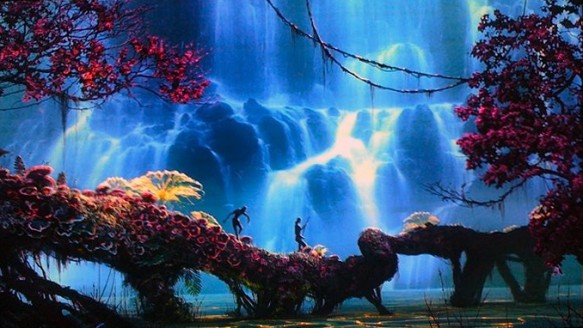
Avatar is the movie James Cameron has been dreaming about for over 20 years. It took that long for the technology to catch up with his vision. Worth it? Yeah, worth it. I usually only see movies in the theater if something is guaranteed to blow up. Avatar met this requirement, and if you wear the 3D glasses, exceeded it. Beyond the explosions and mind-numbing CG goodness, Avatar is a film I recommend for dreamers everywhere.
As lucid dream writer Rebecca Turner suggested, the movie actually feels like a lucid dream. Let’s see: a man goes to sleep, wakes up in a new body, and cavorts around in a magical world full of waterfalls and long-legged sexy smurfs. Except for that last detail, this is the proto-typical lucid dream.
Cameron says the movie was inspired by his childhood romance with sci-fi fiction, and the Internet is awash with theories of his other cultural references such as the story of Pocahontas, Fern Gully, and the Thundercats. But at its core, it is a movie about cultural clash, colonial exploitation, and the dangers/ecstasy of “going native.” As such, it’s a CG remake of the film The Emerald Forest, which also features the destruction of the forest (read: the Amazon) by ginormous bulldozers.
Borrowing from Indonesian Shamanism
These culture clash themes are brought to the climax (won’t spoil, promise) during a communal ritual celebrating the web of life. The participants are tapped into the world tree, and ancestral information flows both ways, to the past, and to the present. According to David Price, a professor of anthropology at St Martin University, this ritual is loosely based on Papua New Guinean shamanism, as researched by University of Southern California anthropologist Nancy Lutkehaus who was consulted for the film.
Cameron’s scene designers actually listened to the cultural consultant. This in itself makes the film worth watching. The indigenous peoples of Papua New Guinea, and indeed, many indigenous cultures in the Western Pacific, are strong dreaming cultures. In an essay in Dream Travelers, Pamela Stewart and Andrew Strathern discuss how indigenous cultures of Papua New Guinea, the Hagen and the Duna peoples, use dreams to communicate with spirits and ancestors. In this worldview, the dead and the living share a network of information, and influence each other.
Another culture in Papua New Guinea, the Kasua, are taught to shape-shift into animals in their dreams. As described in Roger Lohmann’s essay “Dreams and Ethnography” in The New Science of Dreaming, dreamers make a sacred bond with their dream animal. In waking life, this chosen “avatar” animal is taboo to kill.
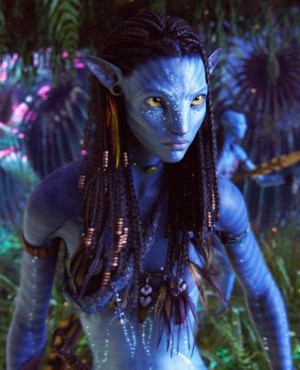
This is reminiscent of the Navi’s relationship to the dragon-creatures they ride and “meld” with; their bond is one of friendship and cross-species communication, not hunter and prey.
Is Avatar political? Nah… it’s just anti-civilization
Closer to earth, David Price also illustrates how Avatar closely parallels current strategies by Western civilization to “get in the heads” of native populations who happen to sit on land and resources we have deemed important to national security. Price suggested that Cameron was alluding to the controversial alliance between the US military and American anthropologists, known as the human terrain system (HTS), which still active despite increasing resistance by the American Anthropological Association.
Price makes the connection to Avatar plain: “Like the HTT counterparts, the Avatar teams openly talked about trying to win the “hearts, mind, and trust” of the local population (a population that the military derisively called “blue monkeys”) that the military was simply interested in moving or killing.”
But Cameron maintains his movie is not anti-American, and his anthropological consultant also denies that she discussed this topic with Cameron and his staff.
Well, if Avatar isn’t anti-American, then it’s anti-globalization.
Dreaming for the Earth
I love sci-fi fantasy for the way it approach political and cultural issues through dreams, visions, and other worlds. But as a lucid dreamer, I know that it’s more than a metaphor. Lucid dreaming can be used in service to the earth’s silenced voices and colonized landscapes. We heal the internal landscape by tending to what shows up.
Turns out, there’s already people living in the vast wilderness of dreams. They’ve been there all along. This is how lucid dreamer Erin Langley approaches lucid dreaming: as a chance to interact with the earth dreaming.
As Erin says, from an indigenous science perspective, dreaming is the real world, and what we do (and who we are) in that realm matters. I like to think Cameron would agree.
Avatar approaches these sticky issues of cultural critique without making the Western viewer feel like shit. Instead, we are given a fresh chance to “go native,” buck the colonial agenda of the globalized uber-economy, and reconnect with the living spirit of creation of which we all participants.
It’s not really that intelligent of a movie, in an analytical way, despite that a linguist created the language of the Navi over a thirteen month period before training the actors.
Rather, it’s somatic. It feels good.
The action/romance/plot falls flat sometimes, but it’s so beautiful, who cares? We know the surprise ending won’t be surprising, and seeing Sigourney Weaver essentially make a caricature of her role as an older, gentler but still chain-smoking Ripley is comforting.
But the dreamy feel of the movie lingers for hours afterwards—I actually saw men discussing it in the bathroom, yeah, in the US—reminding us that we all have an ancestral connection to the planet, no matter how disconnected we may feel thanks to our neolocal lifestyles.
And yes, Avatar hints, we really are cutting down the Amazon, still, at an increasing rate actually, even though those statistics are totally boring to the reading public.
Avatar: it’s a wonderful ride with just a decent balance of action, romance, and deep thinking, although the technological aspects of the movie are by far the most impressive. You’ll walk away feeling transported, and questioning: “Am I dreaming?”
Further Reading about dreams and shamanism:
Dream Travelers: sleep experiences and culture in the Western Pacific, edited by Roger Lohmann, 2003
Entering the Circle: Ancient Secrets of Siberian Wisdom Discovered by a Russian Psychiatrist, by Olga Kharitidi, 1997
Conscious Dreaming: a spiritual path for everyday life, by Robert Moss, 1996
I have seen the movie once. I did not realize that the Navi were a transformed species of smurfs until I read your piece.
There is a lot of useful information for anthropologists in this article.
Your reference to Papua, New Guinea ethnography made me go back to re-read an interesting 1995 paper in the Anthrop. of Consciousness journal. In it, the Marianne George notes that the Barok people of New Ireland, Papua, New Guinea “define dreams as both sleeping and waking experiences….”
Narratives of four dream and dreamlike experiences are reported. One of them is about some instructions sent to the anthropologist by a woman whom she knew, after the sender had expired. I have read comparable reports from present day Egypt. In Egypt, the senders of instructions from the grave were “saints”.
The grouping of certain sleeping and waking experiences into a single category among the Barok is also a reminder of parallels in the Islamic world. Questions about not distinguishing between “dream” and “vision” by Muslim peoples have been raised in English language writings. In Arabic apparently the same word can be used for a dream as well for a vision (hallucination?). George does not indicate whether the Barok also use the same term to describe sleeping and waking experiences.
nice connection, Muhammad. George’s work is really inspiring: she has had some spooky field experiences herself.
Also, reminds me that many Native American cultures do not make the separation either. For instance, in Navajo, “inhabla” can mean waking-vision or sleeping dream.
Excellent article Ryan!
The instant I put those glasses on and became immersed in Pandora I couldn’t help but draw similarities to LDs. Not necessarily the design of the world, but the actual way his conscious awareness was ‘plugged’ into the brain of his Avatar. It was a technology that for me didn’t need explanation… it almost made sense.
I have noticed a new trend with hollywood of late… that of a storyline that involves the mind being plugged into another world… Avatar obviously. Another is ‘Surrogates’… and recently the prequel to Battlestar Galactica, ‘Caprica’ in which people can don strange eye-wear and be thrust into a virtual world. Of course there are older movies like ‘Strangedays’… I could go as far as to add ‘The Matrix’.
I came out of the cinema after Avatar with two thoughts on my mind… the first was “Damn… I got to get my film made” and the second… “we can already do this, without technology”
Great article, Ryan. Loved the movie. Re: Ben’s comment about minds being plugged into other worlds… I see this also as a kind of ‘fallen’ picture of–or at least unconscious emergence of–humanities’ need to reconnect with spiritual worlds.
The best of these movies (archetypally speaking) is the Matrix (as a full trilogy), which actually shows spiritual laws at work. Less well-done are movies like Surrogates and Strange Days which tend to explore materialistic consequences and are less ‘aware’ of archetypal connections. Movies like “Waking Life” are more middle of the road, in this regard.
Ben – right! “we can already do this, without technology.”
Seth – I agree, the Matrix trilogy takes the cake symbolically, altho my favorite will always be the 1st.
and even Wizard of Oz hits on this theme — the imaginal world and its ties to the sometimes dreary reality of, um, Kansas cornfields.
Fantastic insights Ryan. I particularly enjoyed the Papua New Guinea bit. Avatar left me absolutely speechless the first time I saw it (and even more so once I learned a bit more about how Cameron and his team pulled it off with this behind-the-scenes video http://movies.yahoo.com/feature/forbes-avatar-box-office-king.html).
I love Rebecca Turner’s site, but unlike you guys hadn’t made the connection between the movie and lucid dreaming up until now. Interestingly enough though, Dr. Stephen LaBerge just visited us at Stanford Sleep and Dreams and did in fact mention Avatar in a tangential way. That connection is a lot clearer now after reading your piece, and will stay in my mind for a while. Hey, maybe I’ll even try to go to Pandora tonight in my sleep.
Well done mate,
Kevin Morton
“A dream is real while it lasts–can we say more of life?”
cheers Kevin — great to see the Stanford Sleep Lab taking on a public education program on sleep troubles.
Avatar contains very strong connections to dream understanding. and for some the film can be a true Waking Dream experence its also very importent to understand “Avatar has a mirror story at its core
I would like to share a interview with James Cameron and Creg Webb of the dreams foundation
http://www.youtube.com/watch?v=Ixi5swajOJw
Of posable intrest is the refrence to Dream State
and our abilty to access “Atavistic” knowledge
A human Na”vi Avatar is refered to as a “dreamwalker” in the film. Because Avatar is a Mirror story
and a person who “experences”the film in a waking
dream state in theroy may have access to some very deep memorys. from there own inner core heartfelt understanding. it goes far deeper then
one thinks, if there is intrest in sharing dialog on this subject please let me know.
its also interesting to take a deep look at the lyrics
of the song “I see you”