
Any survey of modern dream research must include Calvin Hall (1909-1985). Hall was a behavioral psychologist who explored the cognitive dimensions of dreaming. His work began before the discovery of REM sleep, so little was known about the biology of sleep and dreams. Hall drew worldwide attention for his cognitive theory of dreaming, which was among the first scientific theories of dream interpretation based on quantitative analysis… rather than wishful thinking.
Dreams Images are the Embodiment of Thought
Central to Hall’s cognitive theory is that dreams are thoughts displayed in the mind’s private theater as visual concepts. Like Jung, Hall dismissed the Freudian notion that dreams are trying to cover something up. In his classic work The Meaning of Dreams (1966), Hall writes, “The images of a dream are the concrete embodiments of the dreamer’s thoughts; these images give visual expression to that which is invisible, namely, conceptions.” (p. 95).
So dreams reveal the structure of how we envision our lives, a display that is clearly valuable for anyone who remembers and studies their own dreams.
The Way We See the World
After studying thousands of dreams collected from his students and from around the world, Hall suggested that the main cognitive structures that dreams reveal include:
- conceptions of self (how we appear to ourselves, the roles we play in life)
- conceptions of others (the people in our lives and how we react to their needs
- conceptions of the world (our environment: is it a barren wasteland or a nurturing place?)
- conceptions of penalties (how we view the Man. What is allowed? What is forbidden?)
- conceptions of conflict (our inner discord and how we struggle with resolving it).
As a behavioral psychologist, Hall believed these conceptions are antecedents to our behavior in the waking world. They’re like maps to our actions, and “with these maps we are able to follow the course of man’s behavior, to understand why he selects one road rather than another, to anticipate the difficulties and obstacles he will encounter, and to predict his destinations.” (as qtd in Van De Castle, p. 190)
Content Analysis: the Hall-Van de Castle Scale
Hall’s work is still widely cited today, but his greatest legacy is the system of dream content analysis he developed with psychologist Robert Van De Castle in the 1960s.
Known as the Hall Van De Castle scale, this quantitative system scores a dream report with 16 empirical scales. Some scales are settings, objects, people, animals, and mythological creatures. You know, the sort of things you see walking down the street on any given day. (If you haven’t seen any chimeras or griffins recently, then you’re working too much). Other scales include emotions, sexual content, aggression, etc. .
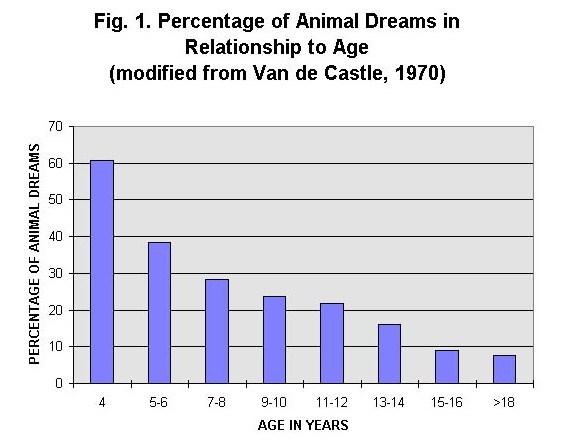
The value of the project is that there are now hundreds of thousands of dreams measured using the HVdC system, creating a “baseline” for normal dreaming cognition. So researchers can add dreams from special interest groups (children, Vietnam vets, Armenian students) to measure their profiles against the norm. (see Figure 1 for an example of the possibilities)
This innovation is a huge milestone in the scientific study of dreams. Now researchers can easily get a snapshot of dreaming cognition that is measurable, quantitative, and statistically significant. Besides psychologists, this scale is still used widely today by sociologists and anthropologists.
And thanks to Hall’s student Bill Domhoff, now a powerful dream research figure in his own right, much of Hall and Van De Castle’s database is available online.
Dream content has coherent meaning—that is the main message behind Hall’s work with dreams. This view later came under fire by the controversial work of neuroscientist Allan Hobson, who implied that dreams may be nothing more than images stitched together from random brain pulses. This rift may be the central conflict in dream studies today.
Thanks for the thorough presentation of Hall’s theory, Ryan. I’ve never encountered his name before. I’m a little bit perplexed though as to why a behavioral psychologist, like Hall, got involved in psychoanalytic research. I guess there’s not much difference between the two fields at that time. Anyway, I think his system of content analysis is indeed useful in providing quantitative data for the investigation of dreams knowing that the latter is filled with abstractions and that subjects who report their dreams may find it difficult to remove subjective interpretations while trying to recall dreams from memory.
Ryhen, you’re right about the issues with dream recall and after-the-fact revision… that is actually one of the central criticisms of Hall and Van de Castle’s system.
That’s why it’s important to understand that dream researchers don’t study dreams per say… we study dream reports. a dream is actually a memory, and memory is highly unpredictable. the critique isn’t devastating to the enterprise of dream studies, but certainly a dangerous pothole along the path.
The story, as I heard it from Bill Domhoff, was that Hall was originally trained as a behaviorist in the 30’s and 40’s, the heyday of that psychological system. He focused on the study of anxiety in lab rats, which he measured by giving them mild electric shocks and then counting the resulting number of feces (which are apparently an accurate index of a rat’s level of fear). I don’t know why Hall shifted toward psychoanalysis and cognitive psychology, but I find it strangely appropriate that his approach to dream content analysis has its roots in counting rat turds.
Kelly, thanks for coming by and also for the behaviorist scoop on Hall!
Great overview of an important perspective on dreamwork. I’m very opposed to a purely materialistic “random neural firings” hypothesis about dreams.
Some nits for you
Calvin Hall’s name does not have Jr. in the title
Our Dreaming Mind was published in 1994 not 93
Domhoff’s book on Finding Meaning etc was published in 1996, not 97
thanks, Bob, for stopping by!
I’ll pick those nits.
Hi Ryan,
Thanks for your overview on the cognitive theory of dreams. I’m writting a research paper on dreams where I’m looking at this theory and Freud’s theory and my argument is that the cognitive theory provides the most clarity in understanding our dreams. I was wondering if you know of any study a psychologist has conducted where he has concluded that a particular dream supports the cognitive dream theory,
I have looked into Domhoff’s dreambank.net website, and found one study that I think I may be able to use in my paper;however, I was just curious to see whether you’ve come across any such study
Thank you so much for your updates on your blog, I’d appreciate a response as soon as you can
Thanks!
Tina
hi Tania am not sure how late this feedback but ..try looking into Deirdre Barrett work she has numerous books and articles on that part she is the chief editor of Dreaming Journal
hope this helps.
Star
thanks Star — and sorry Tina — another comment that got by my radar. in general the studies that support cognitive theory are by the researchers who use cognitive theory. same goes for Freudian theory, Jungian theory, etc. There is no final authority on the meaning of dreams when it comes down to individual dreams. in my opinion — and many dream workers — the final authority is YOU. what feels right? what can you learn? studying dreaming like all cognitive artifacts is a study in meaning-making, and nobody can tell you what something means, they can only lead the way…