Ancestral dreamwork has changed my life, my relationship to the cosmos and the Big Dream, and how I go about my life every day.
But…. I’m gonna be honest here. Although I am buoyed by facing my ancestors, doing so also invites feelings of loss and pain. So much has been lost. As a white guy, I must also acknowledge my own personal privilege when facing ancestors. For example, many of my family’s records are intact, my genealogy extensively mapped. That’s why for me and anyone with western bloodlines, ancestral remembrance must be built upon anti-racism. In order to truly be ancestrally competent, we have to know who we are, where we came from, and what our ancestors are responsible for. As Maud Newton puts it, this work is both a reckoning and a reconciliation to history.1
Our ancestors have seen a lot, and we carry that with us, all of it. It’s a mixed bag. There’s a lot of unfinished business in that bag.
Still, when I invite my ancestors forth, I feel a belonging, a deep-in-my-bones feeling of being with those who care about me the most, and those who support me the most. But even more than that, I feel protected from within—resilient—that feeling that even when life knocks me down, I have the strength to get back up, dust myself off and try again. This is called the ancestor effect, and it’s been validated through a number of studies.2
So I am grateful how my dreams drew me into ancestral recovery, the process of rediscovering identity and belonging that goes deeper than the thin veneer of nationality.
In one dream, I was walking up the stairs and saw a box of Lucky Charms cereal. When I awoke, I had to laugh: could there be a more stereotypical image of Irish culture than a befreckled leprechaun hawking marshmallows at the end of the rainbow?
Then the dreams became more serious. One dream, my grandfather, long since passed, stood over my shoulder, unseen, and pushed a mass of molding clay into my hands.
In another dream,
I am walking down a dirt road through a grassy field with my mother, her mother (my grandma) and her mother’s mother (my great-grandmother, already passed). The four of us are walking all in a line. I felt an excitement to be with them, laughing and chatting.
About a month after the dream, my grandmother was diagnosed with a rare cancer and died weeks later.
Yet one of my most impactful ancestral dream came a full ten years after those initial ancestral journeys. This was a lucid dream, a dream in which I knew I was dreaming.
I walk into a thatched circle building. Inside, there is a hole in the floor, like a well, with a low wall that splits the room in two and ends the midpoint of the well. I put my feet over the edge preparing to jump down. Then I see the proper way to descend is from the other side, which I don’t have access to because of the wall. I see a long rope of braided hair extending from the other side. I decide to jump down anyways when a man suddenly approaches and says No. He’s a thin yet muscular white man, shirtless, with short red hair and tattoos on his face. He looks like family. I tell him, “I want to see my ancestors,” and then suddenly understanding the situation, say, “and I guess that’s why you are here.” He nods his head and says, “Then pray.” Together we go to the low wall which has a wooden cabinet running along it. We sit, and I place my head down on the cabinet, exhaling, blowing away dust from the surface. I continue to breathe, in and out, in this posture.
This dream showed me that there is a slow and guided process to this work, and no short cuts. My work was cut out for me, but now I had a template. To this day, I feel grounded and guided from this dream.
Since then, I have also learned that many healers around the world consider ancestral remembrance to be an important key for Western people to adapt to the future and all the challenges that we face today—and that dreamwork is key to the process.3
But we have to decolonize dreamwork while we cook in this heat: in a Western framework, the central assumption of dream interpretation is that the dream reflects back my issues, my concerns, and my life. After all, it is my dream. Yet dreams reflect so much more. Not only do they reveal our family dynamics, but they also expose socio-economic class, regional affiliations, and the frameworks of our culture-at-large. And we have to decolonize lucid dreaming too, which can be a dumpster fire of problematic paradigms regarding dream control, agency, and icky themes of “exploring” the “wilderness.”
Finally, beneath all that, dreams reflect our humanity and how we are embedded in the natural world, or what eco-philosopher David Abram calls the “more-than-human-world.”
This perspective is not often taken seriously in our western culture-at-large because it goes against an unsaid assumption of materialistic nihilism—that we are each individual cogs in an unthinking machine made up of resources that we are right to exploit as we see fit. This paradigm is what is behind the vicious hydra of the polycrisis, and also the paradigm behind globalism that is actively resisted by indigenous peoples around the world.4
So it takes a little work to reflect on dreams with an openness to the cosmic we. I am strongly biased that part of the evolutionary advantage for strong dreaming in humans is how they not only reflect our embeddedness in nature, but also provide warnings of probable dangers and opportunities for our community. We dream for each other. We dream with each other. This is the cosmic we.
With that, I thank my ancestors for their hard work, their tenacity, and their spirit. Thanks to all my relations, named and unnamed, who support me today. I don’t know if it’s true, but I like to think that my blessings can go back in time, and fuel their integrity, too. They are smiling upon us and sending us courage to do the work we must complete.
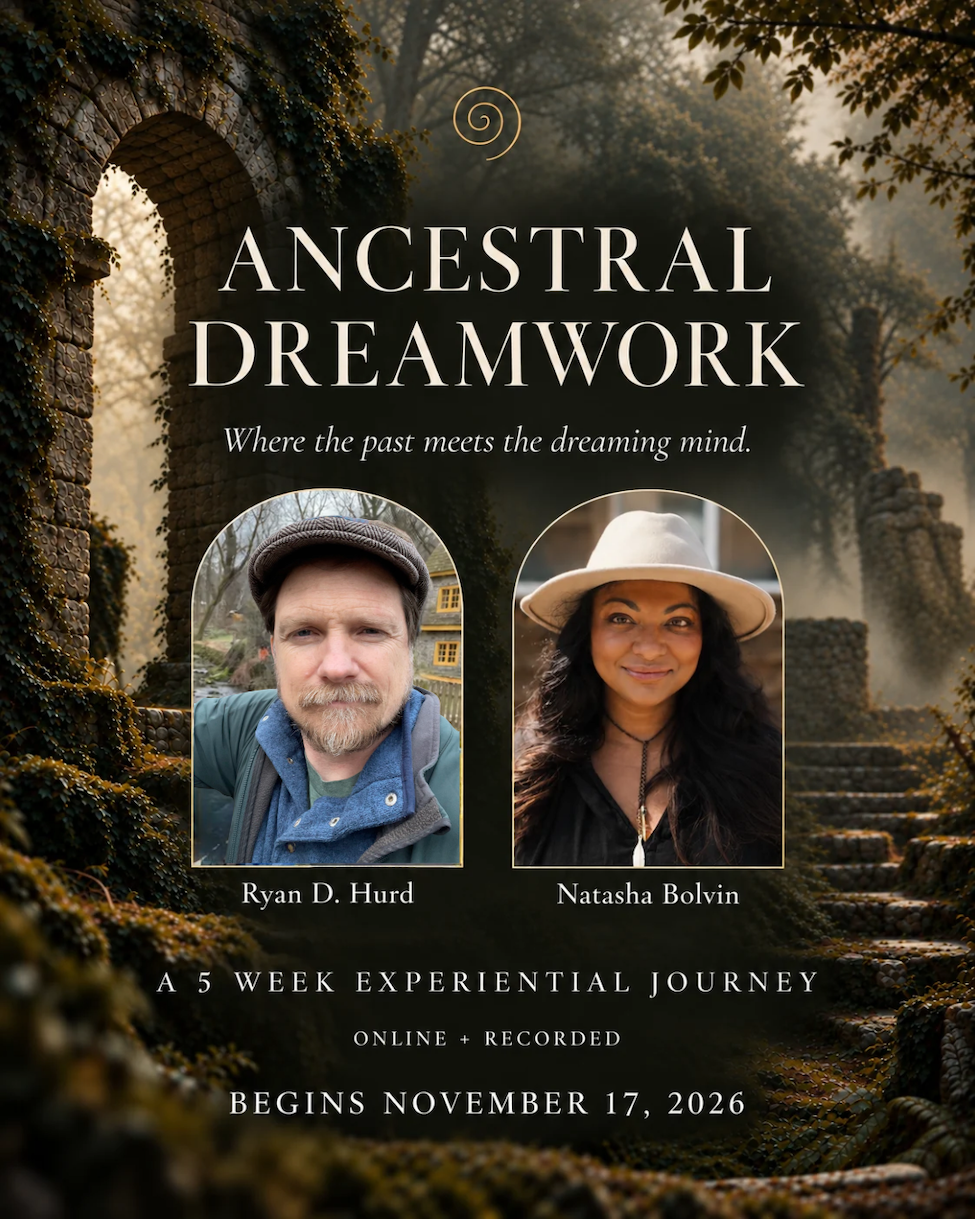
If you’d like to to deeper with me into an ancestral dreamwork journey—check out the online course I’m offering with my Dream Portal colleague Natasha Bolvin. We will focus on how to tune our dreams towards ancestral remembrance (including lucid dreams), and how to honor the dreams that show up.
Learn more here — class starts Tuesday, November 17th.
Sources:
- Newton, Maud. Ancestor trouble: A reckoning and a reconciliation. New York: Random House.
- Fischer, P., Sauer, A., Vogrincic, C., and Weisweiler, S. (2010). The ancestor effect: Thinking about our genetic origin enhances intellectual performance. European Journal of Social Psychology. 41 (1), 11-16.
- Todd, K.L. (2019). Shedding of the Colonial Skin: The Decolonial Potentialities of Dreaming. In: Wane, N., Todorova, M., Todd, K. (eds) Decolonizing the Spirit in Education and Beyond . Spirituality, Religion, and Education. Palgrave Macmillan; Colorado, A. (2019). Woman between the worlds: a call to your ancestral and indigenous wisdom. Carlsbad: Hay House; Kremer, Jürgen and Jackson-Paton, Robert (2013). Ethnoautobiography: Stories and practices for unlearning whiteness, decolonization, uncovering ethnicities. Sebastopol: Revision Publishing.
- Mander, Jerry and Victoria Tauli-Corpuz (2006). Paradigm Wars: Indigenous Peoples’ Resistance to Globalization. Berkeley, CA: Sierra Club Books..
Leave a Reply