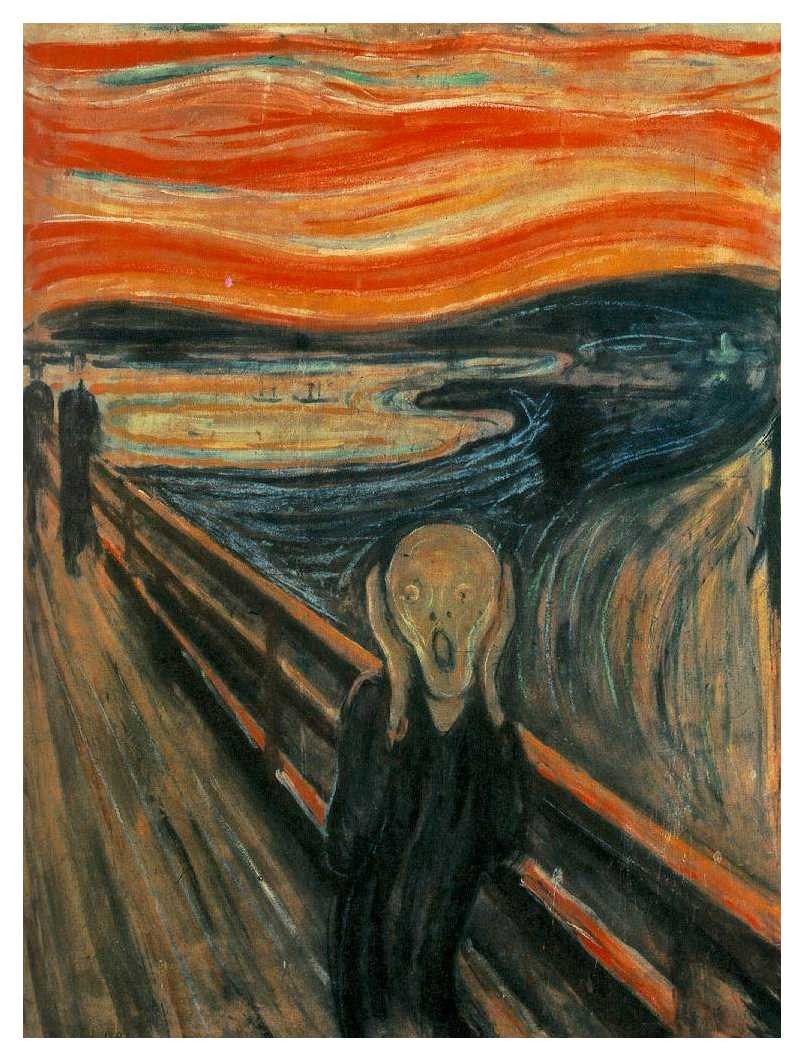
This is part two of my series on lucid nightmares. But first we need to take a sweeping look at how the nightmare in general is discussed and treated in contemporary psychology.
Technically, a nightmare is a dream that the sleeper finds disturbing, and is responsible for waking up the sleeper. Nightmares are scary, but biologically they are defined by this sleep disturbance.
The Cause of Nightmares
We know a few things about why nightmares happen. Nightmares are tied to stress levels in waking life. They also occur, as I mentioned, in people who have suffered intense trauma such as assault, war, or a major catastrophe such as surviving an earthquake, or a terrorist bombing. As such, nightmares are a common symptom of Post Traumatic Stress Disorder (PTSD).
Curiously, nightmares also have some physical causes, such as having a fever, not getting enough air while sleeping, and eating before going to bed. In Dostoevsky’s classic novel Crime and Punishment, Raskolnikov is told his nightmares are not a real problem, probably “Just a bit of undigested potato.”
The truth is, we actually know surprisingly little about nightmares because we, as a culture, have been so hellbent on killing them dead.
Freud’s Influence on Nightmare Psychology
This reluctance to face nightmares started with Sigmund Freud. His Interpretation of Dreams is a great read, but has little to say about nightmares. Freud first tried to fit nightmares into his theory that all dreams are wish-fulfillment. When is a nightmare a wish-fulfillment” When it’s a sado-masochistic wish fulfillment! Somehow this doesn’t quite hold water, but I suppose my disagreement is only a wish-fulfillment to prove Freud wrong (which is what he often told his patients who had dreams didn’t jive with his theory).
Freud’s student Ernest Jones continued this reasoning in the 1930s. Jones concluded that nightmares represent a clash between a powerful wish and an equally powerful repression. So the content of a nightmare, in this view, is sort of like the dust that rises from the battle between the Id and Ego.
This view may have some merit, as repetitive nightmares do tend to escalate, become increasingly disturbing (and direct) over time. Maybe it takes a nightmare, with us sitting up in bed, heart pounding and cold-sweating, to get the message through our defenses.
Since the 1930s, however, scientists stopped studying the causes of nightmares and became focused on stopping them in their tracks. This trend is related to the rise of behaviorism and, later, cognitive neuro-psychology.
Characteristics of Nightmare Sufferers
One exception to this disturbing trend is psychiatrist Ernest Hartmann, who has dedicated years of research to the nightmare and its triggers, its symptoms, and the profiles of its sufferers. Hartmann focuses on the personality characteristics of nightmare sufferers, and his research is surprising.
For instance, according to Hartmann, nightmare sufferers are not more likely to have suffered trauma! Nor are nightmare sufferers more neurotic, or more defensive (as Jones” suggested). Actually, Hartmann suggests that nightmare sufferers tend to have a comparative lack of psychological defenses.
In other words, people who have nightmares are more open to their feelings and the world around them. In fact, nightmare sufferers are more likely to be creative people and artists. Hartmann calls this trait “vulnerability” because these people have a greater ability to be touched by the world, to experience life and all of its pain. So this vulnerability is a double-edged sword, pointing towards both creativity as well as increased suffering.
And also madness. It is true that nightmare sufferers tend to be more creative, but they also have a greater chance, statistically speaking, of being prone to mental illness (schizophrenia). This is the opposite of neurosis – which is having too many psychological defenses in play. Having few defenses is like leaving the barn door open throughout the night, and anyone or anything can wander in and make a mess of things.
Treating Nightmares
In general, a good nightmare is a dead nightmare. At least that is the perspective of many cognitive psychologists and clinical neuroscientists. At heart, this perspective is fueled by an honest desire to end the suffering of millions of dreamers, especially those who endure repetitive nightmares due to personal or collective trauma.
Funded research these days focuses on how to disrupt the neural pathways that activate traumatic memories, therefore preventing access to the root of the trauma. Unfortunately, scalping nightmares through desensitization and psychiatric drugs may leave untouched the original issue that is asking for healing.
And that is the perspective that I take, that a nightmare is a loud call for healing. One of my favorite dream workers Jeremy Taylor shares this view when he writes, “You are having nightmares” Lucky you!” By this, he means that the nightmare is pointing the way towards what needs attention, work, and healing.
One successful approach to working with nightmares is a narrative approach. The dreamer imagines the nightmare and re-writes the story-line. This approach is effective and shows the power that our personal mythologies have over our lives. The dreamer may then re-enter the dream and have the power to get out of the paralyzing fear.
Another approach is desensitization, which is a way to separate the feelings from the imagery so dreamers can move on from a repetitive theme. Eye Movement Desensitization is one popular and effective technique that helps build new thought habits that are constructive and affirming.
Finally, a successful technique is to become aware you are dreaming, and exert willpower in the dream. I’ll discuss this more next time.
Facing the Shadows
Nightmares are not well understood in contemporary Western civilization. And neither are the traits of nightmare sufferers: vulnerability and creativity. Nightmares are a clue to that neglected imaginal realm, and they represent so much more than our greatest fears, but also our greatest strengths, and possibly our genius. That’s why the only thing that is scarier than nightmares is the drive to eradicate them.
Next time, I’ll move deeper into how lucid dreaming and nightmares intersect at the Dark Side of Lucid Dreaming.
hello my name is keith and i need some nightmare decoding. i am 19 years of age and i need some nightmare decoding. i have horrifying nightmares of me and watching other people brutally killing people, i also have dreams of me standing in complete darkness with voices yelling, screaming, whispering. and what do demonic symbols mean in a dream?…if you can decode these dreams, it would be of great help. thank you.
Nightmares are dreams that are literally screaming to get our attention. I recommend writing down the dreams and focusing on the emotions. Try to see if you can link them to similar emotions you may have in waking life. Usually, the nightmare is a dream that is trying to bring some unmet need to consciousness, but the fear can really act like a smokeshield.
As for symbols…. that’s tough. you can look up the history of symbols and see the cultural levels, but personal levels of significance (as well as family level significances) can sometimes invert the meaning, or signify something else entirely. If the symbols are repetitive, what else are they in association with in the dreams? Who else is present? Etc. I don’t know if any dream can be completely decoded (but, then again, can we ever completely decode the memory we have of an important event in waking life either? It’s fractal, and ever changing), but for me emotions are where to start when looking into the meaning of dreams.
Hello my name is alex. i guess i would consider myself a pretty creative person, music, writer, and occasional abstract thinking. I suppose what i want to know is why are creative people so much more susceptible to nightmares-besides the being in touch with the world. In essence, my true question is is it the imagination of creative people that just out of nature takes what ever thoughts come to us and just run with it. I find myself disturbed by horror movies. AT night when i go through the movie i can’t help but continue but in my own way and i can’t stop. I imagine the movie worsened and all this does is deprive me of more sleep. I might be looking for validation but i am also very curious about how i can save myself from the “suffering” your help would be much appreciated. Thank You
Alex, you are certainly not alone as a creative person who is also sensitive to “incoming data.” The connection between creativity and psychological “sensitivity” or “thin boundaries” has been noted anecdotally for hundreds of year. only recently has scientific research into creativity explored the possible connections. and that’s the lead – read an intro or primer on “creativity studies” and cross reference that search with psychology. As for saving yourself regarding susceptibility, I can only speak for myself, which means few horror movies, surrounding myself with people who are creative and dynamic, little to no TV, and a heavy diet of good books and walks in nature. everyone has their own balm, but that’s mine.
I have suffered from nightmares for as long as I can remember.For a time after I had my first child things seemed to get better, yet lately I am quite scared to go to sleep. Granted I am a single mother of two great boys and am often exhausted. I find it hard to sleep, for when I do sleep, at times I sleep so deep, I end up delving into a nightmare and often trying to wake up is hardest my heart beats frantically and at times I am crying. I then go back to bed often delving into one night mare , going from one to the next. In all of them there is always someone dying, myself,my mother,strangers that I do not even know.Every dream is different although I had nightmares of myself dying every night as a young child.I do not know how to calm them or make them go away I drink mellow tea, read a mellow book say a prayer to give me strength but I always get them. Do you have any thoughts?
I had a horrifying nightmare that I was in the middle of this flooded town and waiting for help. I give up after being there for some time and go under then I black out I don’t know why but I wake up and there is a great white shark right in front of me. I swim up to the top when I get to the top the shark starts hitting it’s head on a wall until it’s nose falls off and I try to help the shark eventually the shark dies and sinks to the bottom. I am alone again then three to four boats pass me by and the boat with these people on the boat are really a lot like me
wonderful dream Tabitha! Nightmares really are the strongest kind of dreams as they get our attention and say – hey – this is important. it’s interesting that the shark shows up only after you “give up.” this kind of surrender can really usher in some powerful dream experiences. the white shark may hold some clues for you in future dreams.
I’ve been having nightmares for the last four months, almost daily. I have terrible dreams and I wake up several times during the night. I wake up exhausted and at work, I have flashbacks of the dream and they bring me down.
I’ve been going to the psycologist to heal my emotions, but the nightmares are getting more vivid and they just don’t go away.
However, I worked out last night and finally slept better for the first time.
What can I do to stop having daily nightmares? Can exercise really work?
Hey Caroline,
exercise can increase your levels of deep sleep, which has an indirect effect of the amount of REM sleep you get in the first part of the night, which is precisely when many nightmares occur. There may be more to it than that, however. Check out this article on ways to combat nightmares naturally. (And seeing a psychologist is definitely a good thing too!).
http://dreamstudies.org/2010/09/02/14-tips-for-getting-rid-of-nightmares/
I asked about my nightmares. But i have a question is it lucid dreaming when i have a dream about a beach… the same beach just different decisions are made. Like dif people, exploring the beach instead of swimming. Just curious cuz if i dream about a beach its the same beach everytime. What does anyone think about it? Any one have something similar to this?
I’ve recently been undergoing the same repetitive nightmare for a while now. What I remember is that it’s of trying to escape a blood thirsty young girl in a large all-girl school but I never finish the dream due to the fact that it wakes me up every time in the middle of it. I hardly ever remember a lot of it besides that, and it often causes me to feel stressed and dread falling asleep because of it. I am barely able to get even around 5 1/2 hours of sleep even if I tried, because I dread having that nightmare again. I have had respiratory/breathing problems for the past month though and has made it quite hard to breathe correctly during sleep as well. Do you think that has anything to do with this nightmare reoccurrence? I also tend to fall asleep with a movie (for example, a Batman movie or somethin) or music in the background. But I’ve always fallen asleep with some sort of noise. Could that possibly cause any affect? I would love to actually get enough sleep for once, but I’ve found that quite difficult for nearly two months now.
Hey Maddi,
thanks for the comment. I have a few thoughts: first, I think turning off the media before sleep is a great idea. Music is great for helping fall asleep but it can disturb rest afterwards. movies too, as they sometimes have sudden noises and who knows what else you could be incorporating. Try running a fan instead if you need some white noise.
Secondly, your breathing problems might be connected to the dream. Sometimes allergies and other things can induce problems breathing at night, which can lead to sleep apnea. I’d check that out.
lastly, while I find the content of your dream disturbing, it also seems like a good opportunity to decide to meet the girl the next time she shows up and ask her what she wants. Often when we respond compassionately or empathetically to dream figures, they transform and become more communicative. She has something she wants to tell you, and I guarantee the scariest part is just not knowing what she needs to say. Trust yourself, and trust her. She may simply be telling you she’s exhausted and wants to rest.
Hey, I need some help with my boyfriends nightmares. I’m clinicly depressed and I’ve atemoted suicide and ever since a close friend told him, he’s been having a recurring nightmare for over a month about me being shot in the chest. I don’t know what I can do to help him so, please, anything anyone can offer to help him, I’d be extremely grateful. He hasn’t been able to sleep right because of this, he’s been getting angryer and more upset, he can’t focus during hockey and broke he hand because of it. I’ve been researching things he can do, such as not sleeping on his back, less exposer to violent images, I stay on the phone with him until he falls asleep on most nights, attempting to convince him that there is no possibliy of me being hurt and that we’re both okay, but nothing works. Please, I’m getting desperate at this point, and I worried about him. Is there anything I can do to help him?
Savannah, I would encourage your boyfriend to seek help from a therapist or counselor. His obsessive worrying is clearly affecting his life– and yours! Couples therapy may also be helpful: you are worth fighting for!