Are spirits real, or are they just irrational stories meant to explain things that science now explains better? This is the way the question of spirits is framed by many. According to many recent polls, belief in ghosts in the West hovers around 60%, and one British poll found that more people believe in ghosts than God. These statistics are then typically melded to reinforce the idea that “we hold irrational belief despite all the math we’ve done,” such as this statement from Live Science:
Indeed, humans are prone to believing in things they can neither see nor find logical evidence for.
What this pedantic little reduction does, of course, is ignore all those who turned towards a belief in spirits based on their own extraordinary experiences. In other words, evidence informed not by a belief in spirits (or a belief in logic) but by the senses. In the old days, this was called empiricism.
Extraordinary experiences are the key to another view: This was the topic discussed last week by American anthropologists in San Francisco. It was an inspiring collection of papers titled, “Encounters of Spirits – Towards a New Paradigm.” The anthropologists told their extraordinary stories of contact with the “more-than-human” realm, and how these encounters changed their lives.
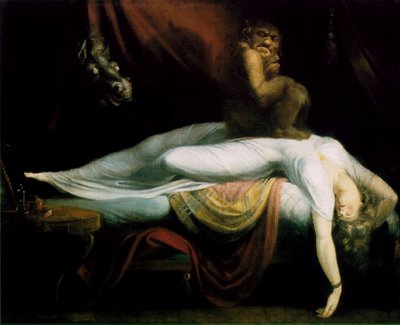
Features of Sleep Paralysis
David Hufford’s paper on sleep paralysis is a case-in-point. (Unfortunately, Hufford himself cancelled at the last minute, so his paper was read, thus invoking an invisible, disembodied presence of expertise.) Hufford suggests that sleep paralysis is marked by features that are similar in all cultures, including:
- awakening
- hearing or seeing someone/something come into the room and approach the bed
- being pressed on the chest or strangled
- being unable to move or cry out
The uniformity of the experience from Polynesian villagers to middle class Americans suggests a biological origin of sleep paralysis, which Hufford has explored as a medical anthropologist for 30 years.
The result of this terrifying experience is that it is usually interpreted as a spiritual experience, whether or not there is a cultural narrative in place to be reinforced.
The Reality of Visionary Experiences
Hufford goes on to argue that sleep paralysis is an example of visionary spiritual experiences that cannot be explained away by irrational beliefs. Besides SP (also known as night terrors, the Old Hag, the incubus effect and scores of more culturally-specific terms), other visionary experiences that have a stable, cross-cultural phenomenology are bereavement visits, and near death experiences. I would add archetypal dreams to this list, as well as out-of-body experiences.
Hufford’s quest is to make sure that Western medical practitioners do not misdiagnose these events as psychotic hallucinations (or culturally-derived stories), but rather view them as encounters that are common to many, and compellingly real. In other words, his concern is not if the entities are ontologically real, but that they are recognized as psychologically real in that they inform personal belief systems, effect behavior, sculpt cultural narratives, and generally make the world go ’round.
Back to the recent headlines (that are timed to promote the new X-Files DVD, by the way), maybe 60% of Westerners believe in ghosts and aliens because of their personal experiences, not their fool-hearty archaic beliefs.
We have to start from this understanding: we personally experience many things that we cannot rationally account for, and ignoring them (or explaining them away by focusing on their biological mechanisms) does not make them go away. We have to work with the cognitive framework we inherited – and we are rewarded when we do so.
For more on transforming sleep paralysis into its full expression as shamanic lucid dreams, check out more of my writings on dealing with sleep paralysis.
Hey Ryan! Lovely post. I’ve only had 1 strong experience with sleep paralysis, and it was hellish indeed. Although I didn’t emerge from it with the feeling that it was a spiritual experience… I woke up and thought “my god, I need to write this up quickly for my blog!” 😉
Question:
You wrote—
“In other words, his concern is not if the entities are ontologically real, but that they are recognized as psychologically real in that they inform personal belief systems, effect behavior, sculpt cultural narratives, and generally make the world go ???round.”
What is the difference between recognizing the sleep paralysis entities as ontologically real versus psychologically real? If something is recognized as ontologically real, wouldn’t it then be recognized that it has an effect on personal belief systems, behavior, etc?
Hey Ben! SP is pretty unique. I should have clarified that I mean “spiritual” as “dealing with spirits” rather than the looser colloquial meaning of “we’re all one!” So a hellish experience with the perceived contact with an “Other” is a spiritual experience by this classic definition.
And great question about ontological versus psychological reality. Once you lift the curtain that hides the social aspects of science, ontological reality is granted to phenomena that experts agree exist without a subject hypothetically needing to be present to notice it. Ontologically real means “objectively” real. (although on the ground it is still a reification by a group of select humans nodding their heads, deciding social norms and determining social status by approving/rejecting a phenomena that is part of an abstract, historically-soaked cosmology).
Psychological reality, on the other hand, includes perceptions that may or may not be rooted in ontological reality, yet are taken at face value by the subject/observer.
So when scientists ask “are spirits real?” and people answer “yes – I’ve experienced them!” we have a disconnect because the scientist is asking an ontological question that is answered psychologically.
We know spirits because we enter into relationship with them (psychologically), not because they affect change in the material world (ontologically).
But most likely the question of spirits’ ontological reality will never be answered unless we were to find some hypothetical mechanism or material correlate or statistically verifiable information-artifact for spirits – which is difficult because spirits are defined by their lack of materiality…..
However, Julie Brechel’s work at the Windbridge Institute is working on this issue with her research on (alledged) mediums – windbridge.org.
I am personally agnostic to the ontological reality of spirits, but I know that tapping into – and learning to deal with – these encounters has psychological benefits, regardless of worldview.
Interesting post. Perhaps the most convincing of these stories is the Hmong Sudden Death Phenomenon back in the 1980’s.
Autopsies revealed no identifiable physical cause for the deaths of Hmong men which occurred primarily in the first 2 years of their residence in the US. Many psychologists and doctors at the time want to treat Hmong refugees according to Western models of diagnosing the individual with paranoid schizophrenia/delusions and hallucinations–perhaps even prescribing antipsychotics to combat these night terrors.
However, Vang Xiong, chose an “alternative” cure instead–calling on the services of a local shaman in Chicago who was able to negotiate with the spirits and cure him in a single night for the payment of leftover meats. Vang was considered one of the “lucky” survivors by the clinicians assigned to the case, in that he survived the “visitations.”
But was it really luck?
Lucider, thanks for coming by, you’ve got a fascinating blog going and I’m excited to find another eco-dreamer on the web.
I just heard about Sudden Death Phenomenon for the first time a week ago – that’s a synchronicity! In my humble opinion, luck comes to the prepared. Also, the work of Leslie Gray comes to mind for examples of how to synthesize western psychotherapy with shamanic models.
I just shared my recent experience on the lucid nightmares study page, but I guess it is more sleep paralysis.
both and!
Has anyone who is talking about sleep paraylsis ever stated that it feels much like when you put your tongue on a 9 volt battery. I’ve had it happen to me a handful of times. ALso, it is like I’M dreaming and when I can open my eyes. I see everything in front of me the way it was in my dream. before , I could open my eyes. About, the 9 volt battery thing. there seems to be some kind of energy running through my body. during this expierence.
I have experienced something similar – like electric shock waves. others experience a “crackle” sound with this feeling. it’s pretty common, and harmless.
Ryan,
After reading through your post I remembered I had read this a while ago and though of how great the information was. At the time I was starting to get into sleep research since I was experiencing sleep paralysis myself I found a video on some of the teachings of the Egyptian book of the dead. In the video they talked about how the Egyptians believed that the devil Apapi, would have to be defeated every night and also is something that must be challenged before entering the underworld. I am not an expert on the subject of Egyptian history, but I believe that the Egyptians were very interested in lucid dreaming and maybe they somehow interpenetrated the stranger effect as this devil.
Just an idea 🙂
Hey, Ryan!
I’ve been having this question in my head,because this 1 dream i’ve been having for 3 days straight,i dont know what it is,but,i’ve been having a some kind of dream of this one spirit/ghost,& it had hit me,& it felt so realistic,& i could feel it!Im in plan shock mood,& i can hardly go 2 sleep,because,i always have the same dream!!& im only 13 years old!Its really freaky,& i’m curious of what it is!! So,can you help me?!
Tiffany, now I’ll be the first to admit that I don’t what your dream means! But it’s clear that something is trying to get your attention. Tap tap tap. So, can you tell me where the spirit/ghost –as you say– hit you in the dream? This is an important clue — it’s OK if you don’t respond to this comment, but start there and see what you uncover. A good follow up question is — when in waking life are my energies drawn to this spot? (assuming it’s the same, it may not be)
Lee – that’s a fascinating idea — I don’t know much about Egyptian cosmology — but the next step would be to find symbolic evidence of being held down, paralyzed/wrapped up etc in the mythology of this underworld confrontation. I know some one who reads ancient egyptian, so maybe he can join our crack team. extreme sleep paralysis!
In 1997 I began to experience these “entity” visitations when I would sleep. I was tormented nightly. My fear made it difficult to sleep. Eventually the sensations persisted into daytime hours. The sensation of a malevolent entity sitting through me or next to me was almost constant. It would often move erratically in order to startle me. It seemed to grow stronger with fear.
These events came at a point of spiritual transition for me. In 2004 I discussed it with a doctor. He told me I was nuts and prescribed me an anti psychotic. I took the medication for 3 days, during which time the effects went away. I quit the medication and the feeling came back, but this time I was able to cope with it psychologically. I am now able to turn it off and on at will. I have a good theory on how this all happens neurologically.
Rich – thanks for your account and I apologize for not replying in a timely manner — your comment came just as I moved across the country. I would definitely like to hear your thoughts about the neurological side of SP.
I too have had interesting experiences dating at least back to age 12 or so. The worst of them was when I woke to my blankets shaking violently and Satan speaking gibberish in my right ear. I could hear the sound of people screaming and grinding their teeth. I knew I was being visited by Satan and hearing the sounds of hell. I was terrified but paralyzed and unable to move at all. This persisted for a torturing seeming eternity then began to fade. Eventually I could wiggle my toes and fingers but couldn’t call out to my mom. Finally I was able to move my body and went to my mother’s room. The only time I ever went to her room to sleep. I sat up the entire night terrified. In the morning she inquired and I shared my experience. She said she had similar experiences with being levitated and rotated above her bed while she slept a few years earlier as an adult. She told me a religious excuse for the experiences; Satan tries to get to those whom God loves to try to win them over. That made no sense to me then or now. She had only been Christian for 2 years at that point so the stressing of religion (being ‘on fire’) was still quite strong in our household.
As an adult during my pregnancies I have insomnia with extreme anxiety, like surges of electricity rushing through my body. The closer to sleep I get I can feel the sensation of something trying to enter me (through the chest area – non sexual).
Once during a moment of rest while getting my baby to sleep I felt a cat jump onto the foot of the bed. I realized there was no cat in the house and when I looked it was an enormous spider about a foot tall walking towards me and my infant son. I instantly flipped the blankets over it and screamed for my mom and aunt who were in the living room. When they came and I pulled back the blankets there was nothing there.
I had for many years associated these experiences with religion and spirituality yet as I learn more about the psyche and physiological processes of sleep especially when related to hormones and stress, science tends, for me, to win the argument.
Thankfully the sexual aspect of sleep paralysis had never been an issue for me. The sleep paralysis remains nonsexual and the powerful sexual dreams I have are with real people and, for me, are highly rewarding!
Mary, I actually read that post as well and I’m so glad that you aneesrwd it in this compassionate loving way. I’m trying to get our daughter out of our bed, but it is so comforting to her when I hold her in the middle of the night. She can be insecure and I know that it helps her sleep more deeply and soundly.
Yea, i had similar experience, but it does not happen only in midnight, but also when i take a nap. My Thinking is active but my muscles are not. I might understand that i am moving my feet, but really i cannot.even i cannot cry out. when i think harder(that my soul is out of my body,ghosts came,etc etc)then it gets more dangerous and my heart beats very fast. when i calm down…..slowly and slowly…..i can feel something is connecting from brain to my rest of the body…then i can move my hands feet and then wake up….afraid,thrilled and shocked by the trauma of the Experience.
Hi I just had a dream literally 30 minutes ago. And by far it has been the scariest dream. I’ve never really told anyone this but when I was younger, I’d say 8 or 9 I had a vision. Before I had this vision I was watching this show on some channel that a woman had been mauled and killed by a mountain lion in a forest somewhere during the winter. I was scared. For a second the only thing I could see was the girl being mauled. It was almost like I was the animal. Ever since then I have repressed deja vu moments. However, I’m 16 now and they’re starting to comeback. The deja vu has become so bad that sometimes I get them confused with memories. But now I have another problem the dreams. I’m having the problem where I begin to hear voices and I cannot wake up. I remember one dream where I saw numbers and shapes. But now the dreams seem to be getting more intense. For instance a couple of weeks ago I had a dream where everything was pitch black and I could hear someone laughing and then the laughing seemed to get louder and more people were laughing. I woke up from the dream luckily. But tonight no more than 40 minutes ago I had a horrible dream. I dreampt …….nothing I was asleep and I couldn’t wake up and then I saw rats then everything went black again. Then for some reason I was praying and I said “God I have overcome you.” And I heard-…..I heard the scariest noise I have ever heard in my life. It was like a hissing noise saying “yayayyayayyayayay” over and over again. Then my body started to shake…. I then woke up from the dream and grabbed my bible and prayed to god and said that I was sorry abd repented for what I said. I was scared.. I turned on the light and decided that I wasn’t going back to sleep. Then I went online to see what this was. Dream paralysis? The….the old hag?…..I’m scared and I don’t know what to do…please someone give me an answer.
Dimitri,
WOW! Your “SP” experience began at such a young age. You sound like a pretty brave kid (both in and out of your dreams). Based on your intimate details, it would not be shocking to learn of your slight admiration for the superhero “Superman” Good news is that, since you’re only 16 years of age, so, you have ample time to grow out of it. If nothing else, you can train yourself on ways of managing or coping with obstacles that impede your growth. Furthermore, training will help you master the presence of reality and/or lack there of. One helpful tip might be to keep a record of your “SP” encounters. At least this way, you can detect reoccurring events/episodes that keep you drowning and anchor your Superman undies, throughout your adulthood. Ultimately, the objective would be to gain control and deepen levels of growth but, for now, lets see what the future holds. Best of Luck!
hello my name is Ashley. I am 22 years old. I have been having these nightmares these dreams of not being able to move, or like something is holding me down and i cannot scream or do anything, I have had these since I was probably In the 8th grade. Sometimes they get so Clear and It feels like something very evil Is trying to keep me down sometimes there are other people in the dreams but they never seem to help me. I Have learned to try and stay calm, but last night it happened again which was the first time in a few months, and it sparked my curiosity to look them up and see if I can get some answers on How to maybe control them better, Because I tend to wake up in a cold sweat in which seems like a nightmare that last forever, and every time it feels like its not a very good presence I never feel happy or calm I try to keep myself as calm as possible because I know that it may just be a bad nightmare, I have have other experiences, weird dreams of falling from high distances in the sky and landing perfectly fine on the ground, or my dream ends right when I hit, I even get the actual adrenaline from falling I can feel everything until I hit then I feel nothing. If any one has any thoughts on this please give me a shout I would like to try and calm these down or learn to deal with them in a better way. Thank you -Ashley
Hello, I am 21 years old and I experienced sleep paralysis a few times, before I even knew what it is…
One episode that happened..maybe 2 months ago I remember like it was a real life experience…
I get nightmares every night, so I am very used to those things…i wake up easily, aware that those were just nightmares and go back to sleep, not scared at all.
But that time…
5 AM.. My husband went to work and closed the door…I saw him doing this. Then, I started to hear a BUZZ. I don`t know how to explain this buzz,it was something between a bee buzz and a rotating gear buzz…
Then, I saw a dark silhouette entering through the door. I asked myself why my husband is back…then i felt like it is not my husband but something evil. It came towards me, layed onto me and started whispering in my ear words I did not understand.
The buzz was stronger and i could not move, I was terrified, I wanted to make a cross with my hand and could not move it.
We have an oil lamp from the church and that morning it still had a small fire…I looked at it and I felt like it was an evil light…
Then I could move, the evil thing disappeared.
That was the first time in my life when I couldn`t go to sleep back…but more, I didn`t want to go, I turned on all the lights in the house and called my husband.
very creepy! SP is very common when we sleep alone — especially for people who are accustomed to sleeping with their partner. to prevent more of these things, if it were me, I’d make sure to give myself plenty of time to unwind and relax before bed. prayer, music, a hot bath: all of these are wonderful rituals for going to sleep.
I ocassionally experience SP. most people do every once in a while. I only seem to get it if I’m taking a nap long enough to enter REM. I am a neurophysiology technician so when it happens to me I don’t find scary or alarming as others do because I understand exactly what’s going on. For me it’s just an annoying inconvenience.
That said, the experiences do come with the typical feeling of being too heavy. Also, if a tv is playing in the background whatever is actually on gets twisted into some more sinister version of itself. I never experience any odd energy or sound sensations. I just get annoyed that I’m conscious but can’t move yet.
As I understand it, the body is still under the influence of the neurochemicals inducing paralysis during REM. SP experiences are associated in a higher frequency in people with narcolepsy as well. If this is happening frequently a person should consider getting a sleep study focusing on REM sleep disorders.
Hi I am 21 years old. A couple nights ago I had a dream I went to the movies with 2 friends. The movie we went to watch was called the Devil inside. During the movie in my dream some one opened a door in the theatre and a black figure came though the doorway into the theatre. My friend said hey do you see that at the same time I was looking at it and at that exact same moment MY body felt like it had just been token over oR something. It was to real I could not move but only hear. Plz WOULD LOVE TO HEAR WHAT PEOPLE THINK
I have these deep sleep where I cannot move speak but my mind is always racing I find that if I pray the Lord’s Prayer and Hail Mary it literally feels like I am being unwound and then I can open my eyes and breath and will myself to move my feet and this then wakes me out of the trace I have had it for years but this method works for me. It’s bloody scary being in that helpless position.
I’ve been experiencing nightmares at least 1-5 times a week about Ghost holding me down. I’ve had the same recurring dream of this house since I was a teen. I’m 50 now and the dream is happening more and more frequently . I almost feel like I was haunted in my past life, lived in that house before. I usually wake up around 2:37 am with a ghost or spirit holding me down. I don’t see faces but last night I saw small hands of something holding me. The hands grabbed me from behind and I saw them on my shoulders I felt paralyzed and I couldn’t get away. I was scared to death when I awoken. I’ve also had times when I was dragged across the floor, and they tried to put me into a room in that house, I felt complete terror. The house has a basement that goes underground, with tunnels. They’ve tried to drag me down the stairs into the those tunnels and I wake up terrified. I have had that happen a hand full of times and never forgot the terror. Everyone of my dreams are in the same house with different happenings.. I felt something holding me down and I can not get up. I’ve been sexual assaulted in a couple and fought to get away. I sleep with a light on because I’m afraid to sleep in the dark. When I awaken I search the house and everything is always okay. I have a hard time going back to sleep because I am scared of my dreams. This is the first time I researched my dreams, I think my dreams are trying to kill me.
I’ve had hypnagogic experiences off and on most of my life. The theme is always the same: people who have passed on visit me. I sought help to try to make them stop because I experienced them as disturbingly real. It took years of asking professionals and researching this phenomenon to finally discover the word hypnagogia. I even tried tricking the experience by questioning the “visitors” but was unable to stump them as they would come back at me with unexpected answers. I’ve struggled to make them subside and have been fairly successful. One stands out as very different from the rest. It was nothing but a mass of energy–like seeing electrical current in the air–and seemed to try to frighten me. Some visitors explained to the me that our worlds were closely linked but in another dimension. I’m so uncertain about what consciousness is, if it exists within or outside the brain, and why these experiences seem so real.